
Lind Capital Partners Municipal Market Commentary
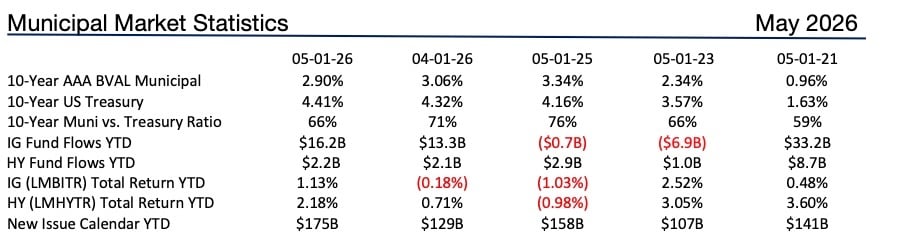
Municipal Market Performance and Benchmark Rates: April 2026 was largely defined by intensifying geopolitical instability and a Federal Reserve that solidified it’s “higher for longer” policy stance. As the conflict in Iran shows no signs of resolution, resulting in elevated energy prices fueling inflation concerns, bond markets were left to recalibrate in the final week of the month. In the end, US Treasury rates were roughly 7bps higher month-to-date across the curve, leading to a (0.18%) loss for the US Treasury Index (LUATTRUU). This marks two-consecutive months of negative returns, marginally increasing YTD losses, which now stand at (0.22%).
The municipal market outperformed and recovered from last month’s drubbing, when both indices shed +/- 2%, to increase year to date returns, which remain firmly positive. April is historically a challenging month for the municipal market, contending with tax-related selling, weak reinvestment demand, and accelerating supply. Coupled with aformentioned US Treasury market volatility, one would expect the municipal market to be exceptionally vulnerable, but the municipal market was remarkably resiliant. The Bloomberg Municipal Bond Index (LMBITR) returned 1.15% this month, returning to positive territory YTD, which now stands at 1.13%. The Bloomberg Muni High Yield Index (LMHYTR) outperformed its high-grade counterpart for the fourth consecutive month, returning 1.47% in April (2.18% YTD). Despite a late-month hiccup, AAA municipal benchmark rates generally moved lower throughout the month with 5, 10, and 30-year rates anywhere from 9-15 bps lower in yield by month’s end.
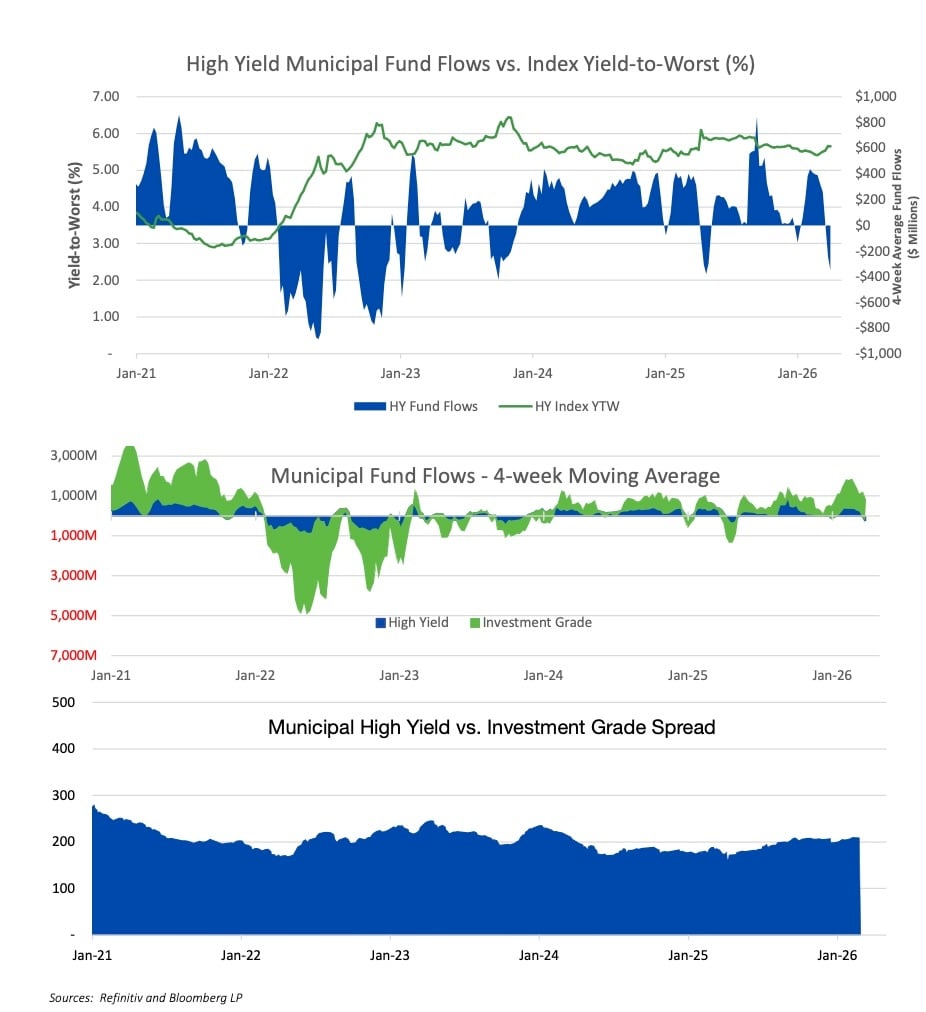
Mutual Fund Flows: As of this writing, year-to-date municipal bond fund inflows total over $18B, representing the second highest level (for the comparable period), on record. April inflows, while not overwhelming, contributed to these record totals. Municipal bond funds experienced inflows in 3 out of 4 weeks this month, totaling $2B. High-yield bond funds attracted inflows in each of April’s four weeks, totaling $100M.
Primary Market Supply: The muncipal new issue market posted it’s second consecutive month of primary supply exceeding $50B in April. After setting primary issuance records in 2025, the municipal market shows no signs of slowing down in 2026, as YTD issuance totals approach an increase of 10% year-over-year. While this year’s April total was down slightly versus ’25, the $50B+ figure is 22% higher than the trailing 5-year average. While high-yield issuance has been mixed (but largely in-line with historical averages), forward calendars from the underwriting community point to a busy end of Spring and beginning of Summer, where opportunity in this elevated rate environment should persist.
Lind Capital Partners Municipal Non-Rated Market Commentary
The Brightline Train is back in the news again, and again, not with positive news. We discussed the Brightline Train in our September 2025 commentary when we highlighted the financial challenges of the 235-mile high-speed rail route between Miami and Orlando. While ridership has increased, the growth has not been sufficient to stave off continued financial distress. In March, S&P downgraded Brightline Trains to CCC-, highlighting the increased probability of a distressed debt exchange that would be tantamount to default. Bloomberg recently reported if negotiations between bondholders and the borrower are not resolved or an equity infusion is not obtained, Chapter 11 bankruptcy filing is a possibility. As an interested onlooker, we are not privy to or involved in any of the discussions, but the headlines reinforce our strong belief in the importance of bondholder protections and security provisions.
It is inevitable for there to be borrowers in the non-rated municipal bond market that face financial stress, but avoiding these credits and mitigating the potential impact of distressed situations can done through thorough initial underwriting and ongoing credit surveillance. First and foremost, identifying sectors or borrowers that are more likely to face stress and avoiding them is our first line of defense. For portfolio holdings, the foundation of our credit process is the understanding and valuation of the collateral protection for investors. Almost all our portfolio holdings are secured by a first mortgage pledge of underlying assets, a debt service reserve fund (protection from short-term payment interruption) and financial and operating covenants designed to alert investors to impending financial challenges. These structural provisions provide investors protection in the event of financial stress.
In the event of default, we rely on these structural protections to protect our principal investment and maximize proceeds in the event of final distributions. We are in the process of closing the final chapter of an investment in a senior living community in Minnesota that has been in default for a couple years. The borrower’s financial stress was largely due to a slow recovery from effects of the COVID-19 pandemic, which caused its legacy facilities to underperform is newer, stabilized campus.
During Q1, the market price of a senior living credit, Crest View Senior Communities, rose from $55 to $95 after the borrower announced a planned redemption of the bonds at par plus accrued interest. Over the last several years, we have actively worked with the bondholder group and the borrower to determine the best path forward for the credit, which ultimately resulted in a sequenced disposition of the facilities. As asset sales were completed throughout the default period, the borrower paid down principal and past-due interest on the bonds from sale proceeds. Ultimately, bondholders will receive a full recovery, a validation of the value of the underlying collateral.
In the majority of issues we participate in, the security pledged to the bonds includes a first mortgage lien on the real assets. This provides our investors with an additional layer of risk mitigation and is a key component of our credit due diligence process. As we continue to watch the Brightline saga unfold, we take comfort knowing our portfolio holdings have embedded structural provisions designed to protect our investors should financial performance fall below expectations.
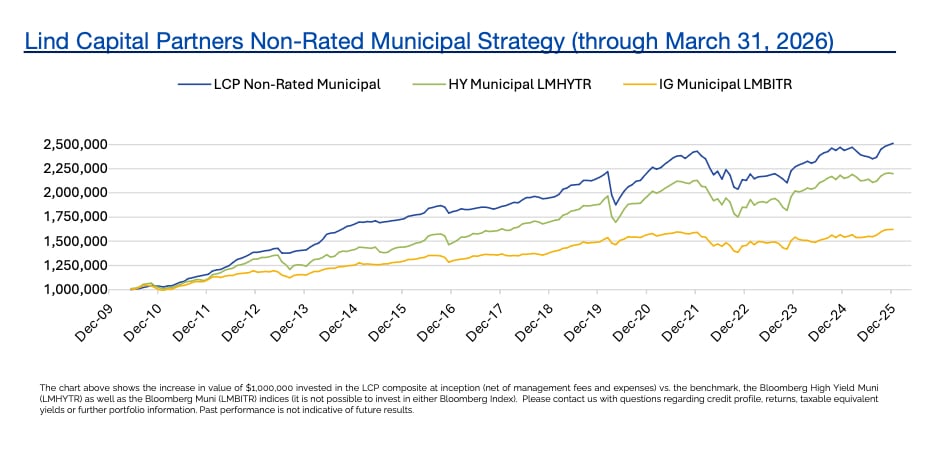
The chart above shows the increase in value of $1,000,000 invested in the LCP composite at inception (net of management fees and expenses) vs. the benchmark, the Bloomberg High Yield Muni (LMHYTR) as well as the Bloomberg Muni (LMBITR) indices (it is not possible to invest in either Bloomberg Index). Please contact us with questions regarding credit profile, returns, taxable equivalent yields or further portfolio information. Past performance is not indicative of future results.
Lind Capital Partners Municipal Market Charts