
Lind Capital Partners Municipal Market Commentary
Municipal Market Performance and Benchmark Rates: Fixed income markets in June 2026 were shaped by a tug-of-war between easing (then re-escalating) geopolitical pressures and persistently hawkish central bank tone. June marked Kevin Warsh’s first meeting as Fed Chair, and while the Committee held the federal funds rate steady (3.50-3.75%), his debut signaled a more hawkish stance amid persistent inflation.
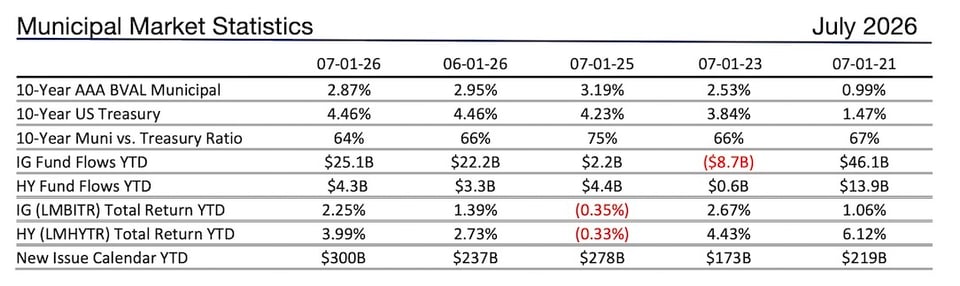
Driven by powerful seasonal tailwinds, the municipal market demonstrated sustained relative strength in June, even amidst record-setting supply, outperforming the US Treasury market for the third consecutive month. The AAA municipal benchmark curve bull flattened in June, with the long end leading the rally, as rates fell by 22 bps in 30 years and 3 bps in 5 years. The Bloomberg Municipal Bond Index (LMBITR) returned +0.90% this month, extending year-to-date returns, which now stand at +2.25%. The Bloomberg Municipal High Yield Index (LMHYTR) outperformed its IG counterpart, and delivered a +1.23% return in June, driving year-to-date gains to +3.99%.
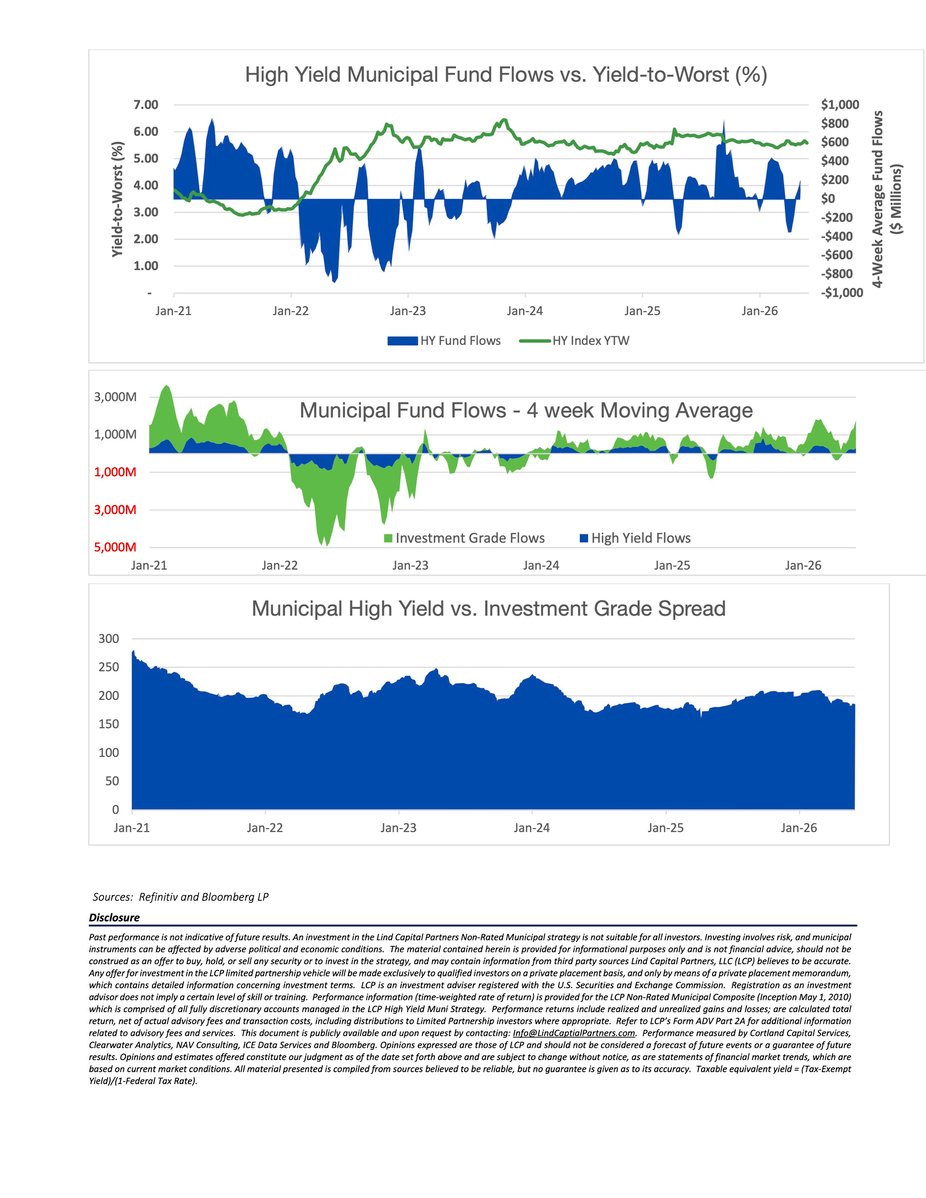
Mutual Fund Flows: June fund flows in municipal pooled vehicles told the same story they’ve told all year – investor capital remains firmly committed to the asset class. Open end mutual funds and ETFs experienced inflows all four weeks in June, extending the inflow streak to 10 consecutive weeks and 27 out of the last 29 weeks since December of last year. Year-to-date inflows now total over $50B, marking the second highest level on record through the first half of the year. Owing to the retail-heavy composition of the municipal market, fund inflows represent a powerful technical driver across the broader market.
Primary Market Supply: Mirroring the demand picture, primary market municipal supply is also in record territory in 2026. Year-to-date supply now totals $315B, an increase of 8% versus 2025, a record-setting year itself by a wide margin (+17%). Municipal supply in June totaled over $65B, an increase of 10% YoY and roughly 33% higher than the 5-year trailing average for the month. After a relatively lackluster start to the year, non-rated issuance finally started to pick up meaningfully in the latter half of June, evidenced by a significant increase in deal flow, with LCP evaluating 8 to 10 transactions per week.
Lind Capital Partners Municipal Non-Rated Market Commentary
Over the last few months, there have been several high profile municipal credits reporting distress or default. In June the Nassau County Settlement Corporation failed to make a debt service payment on $431 million Tobacco Settlement Bonds. Unlike the Brightline Train (see our May Note) or American Dream Mall (which also missed a debt service payment in June), this news has far broader implications for the high yield and investment grade municipal markets.
Unlike high profile defaults we have highlighted in the past, the challenges confronting Nassau County are being faced by all tobacco securitization issues. While many states and municipalities issued debt with different issuers/borrowers, all are ultimately secured by the same source of payment (unless other enhancements are provided). As a result, investors may be surprised to learn the underlying security and collateral is the same across all unenhanced tobacco bonds, and their municipal portfolios may lack the intended diversification.
Similarly, investors in mutual funds will find that both high yield and investment grade municipal bond funds are widely populated with tobacco debt. Our cursory analysis of the bellwether Buckeye Tobacco issuance (5% coupon due in 2055) showed broad ownership across both fund types. Roughly 58% of the outstanding debt is held by high yield mutual funds while 27% is held in national funds. This is relatively common for “Beta” high yield issuers. Investment grade funds typically invest in sub-investment grade or non-rated bonds up to a defined percentage to increase yield on the portfolio. The largest, most liquid deals, such as Buckeye Tobacco, provide relatively easy market access to buy or sell securities based on fund flows.
Because the MSA assures cash flows in perpetuity, bondholders should ultimately receive payment on their tobacco debt. However, timing is the great unknown, and can negatively impact the yield earned by investors. The Nassau County tobacco default highlights a risk in the municipal bond market that we suspect is largely unknown. Future defaults within the sector, which we view as inevitable, will put additional pressure on the market, particularly if they trigger an exodus from mutual funds, high yield and investment grade. In any case, the financial stress on the sector will continue to be a drag on mutual fund performance for those that invest in the sector.
LCP has only used tobacco securitization debt as an opportunistic investment during periods of severe price dislocation. Instead, we focus intently on our target revenue-bond sectors, which have not exhibited the same degree of credit stress as the recent high-profile headlines. We will watch the tobacco sector closely as it seems likely that there is more turbulence ahead. As they say, “where there’s smoke, there’s fire”.
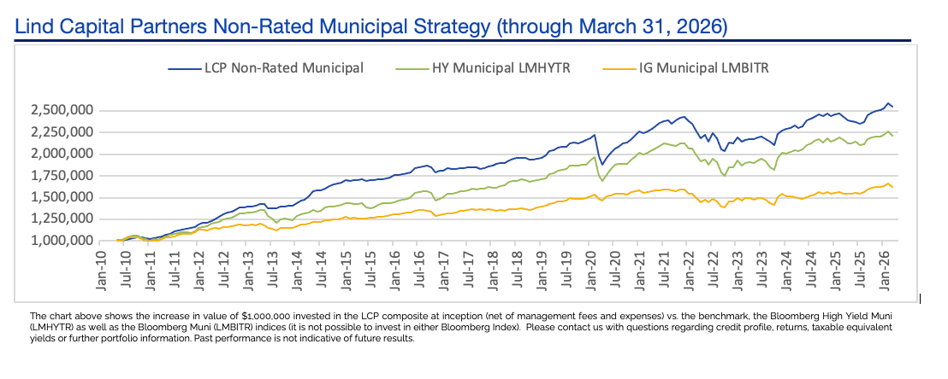
The chart above shows the increase in value of $1,000,000 invested in the LCP composite at inception (net of management fees and expenses) vs. the benchmark, the Bloomberg High Yield Muni (LMHYTR) as well as the Bloomberg Muni (LMBITR) indices (it is not possible to invest in either Bloomberg Index). Please contact us with questions regarding credit profile, returns, taxable equivalent yields or further portfolio information. Past performance is not indicative of future results.
Lind Capital Partners Municipal Market Charts