
Lind Capital Partners Municipal Market Commentary
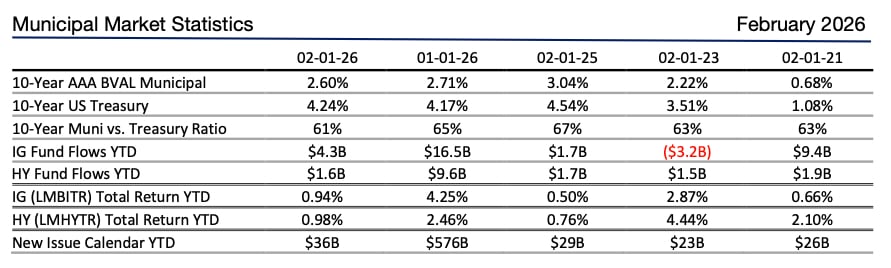
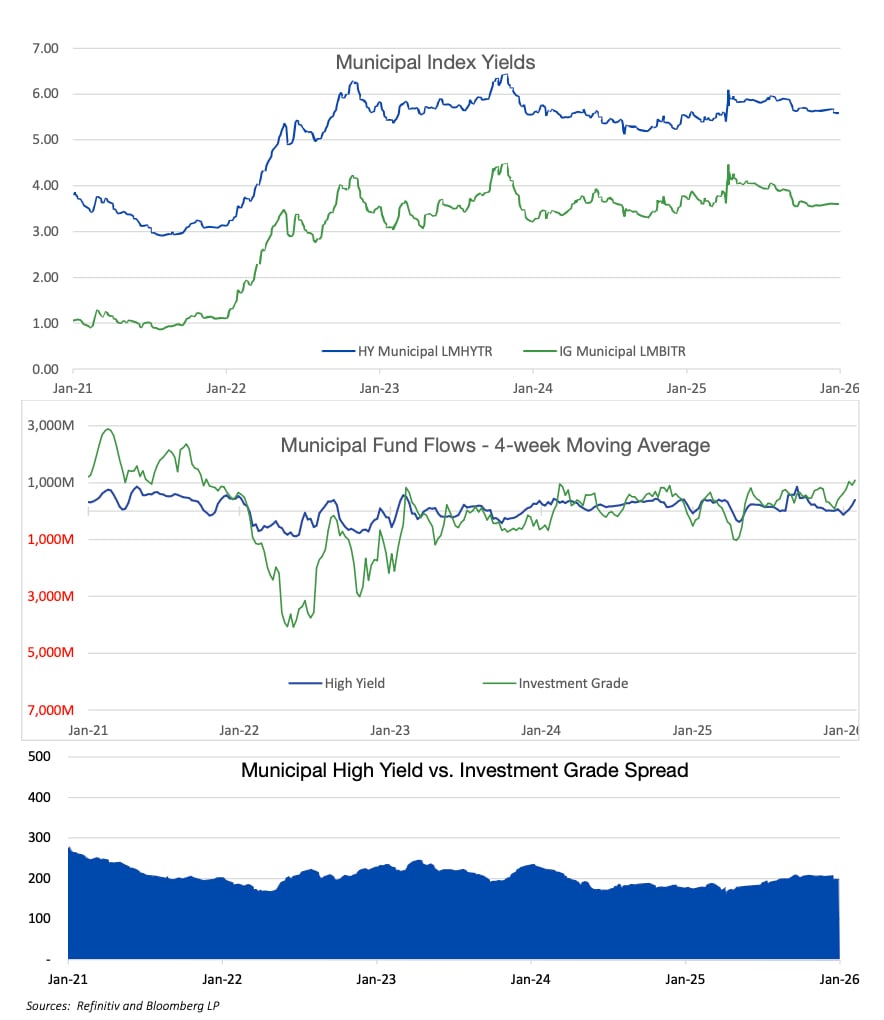
Municipal Market Performance and Benchmark Rates: As is customary, the municipal market got off to a relatively sleepy, but strong, start to the new year. The so-called “January Effect,” where elevated seasonal demand outpaces slowly building supply, defines the first month of the year in the municipal market, historically. Both municipal indices finished January in positive territory, with the Bloomberg Muni High Yield Index (LMHYTR) marginally outperforming it’s high grade counterpart (LMBITR), returning +0.95% vs 0.90%, respectively. The AAA municipal benchmark bull steepened this month, as 5 and 10-year benchmark rates were lower by 14 bps and 10 bps, while 30-year rates rose by 3 bps.
The US Treasury market has been no stranger to geopolitical and policy uncertainty recently, and January was no different. Renewed trade tensions and tariff threats releated to the Administration’s keen interest in Greenland, as well as “de-dollarization” headlines, led to UST volatility that ultimately pushed rates higher this month. UST rates in 5 and 10 years were 8 bps higher while 30-year rates rose 4 bps by month’s end. The FOMC took a “wait and see” approach at January’s meeting, unsurprisingly leaving rates unchanged, before President Trump announced his choice for Fed Chair Powell’s successor, fomer Fed Governor Kevin Warsh.
Mutual Fund Flows: Municipal funds picked up where they left off in 2025, posting four consecutive weeks of inflows totaling over $6.5B in January. This marks weekly inflows in 17 out of the last 18 weeks dating back to September of last year. Inflows this month were broad based, by vehicle and credit quality, as both ETFs & open-ended mutal funds and IG & HY, experienced positive fund flow momentum. High-yield inflows totaled $1.6B in January.
Primary Market Supply: Following the end of year holiday lull, January is traditionally one of the lighter new issue months as borrowers incrementally re-enter the primary market. New issue volume totaled close to $35bn in January, 8% lighter than last year, but still elevated (+12%) versus the trailing 5-year average for the month. The high-yield primary followed a similar pattern, taking a few weeks to get it’s footing, but has ultimately started to build. Market consensus generally predicts another year of record ($600bn+) issuance as infrastructure needs, and the nominal costs of those projects, rises.
Lind Capital Partners Municipal Non-Rated Market Commentary
Throughout our 15+ years of managing non-rated municipal bond portfolios we have always tried to impart our view that most of what we do is basic “blocking and tackling”. This should not be surprising given we invest in bricks and mortar operating businesses providing an important service to their communities (hence tax-exemption). Initial and ongoing credit surveillance relies on thorough analysis of operating performance and monitoring operational trends.
What makes our strategy so interesting and rewarding is the inherent inefficiency of our market and its many idiosyncrasies. The municipal bond market is comprised of approximately $4 trillion in outstanding debt with 50,000+ issuers and over 1.2 million individual CUSIPs or securities. Compare that to the corporate bond market with roughly $11.5 trillion in outstanding debt and 30,000 individual CUSIPs. Additionally, municipal issuance is largely reserved for capital projects and thus most borrowers are in the market infrequently. Combined with a largely “buy and hold” retail investor base, this is a recipe for inefficiency. An inefficiency that can be exploited for investor benefit.
Additionally, the municipal market has unique idiosyncrasies that active portfolio managers can use to their client’s benefit. We highlight statistics every month that provide some insight into these market dynamics that municipal market participants understand but might not be so obvious to the general municipal investors. So, here they are and, more importantly, what they mean to us:
Municipal vs. US Treasury Ratio: Indicates the relative attractiveness of the municipal bond market compared to the US Treasury market. The current 10-year ratio 61% indicates the municipal market is expensive relative to US Treasuries. The after-tax yield on a US Treasury Bond will be higher for investors with marginal tax rate less than 39%. Low ratios should dampen investor appetite for the asset class and could lead to temporary dislocation. Institutional investors who move between taxable and tax-exempt fixed income markets will likely be on the sidelines.
Mutual Fund Flows: These are the primary indicator of retail investor demand and a source for market supply, when fund flows are negative. Retail investors often operate with “herd mentality” moving in unison which can increase market volatility. As we often note, open end mutual fund provide investors with next day (T+1) liquidity. This cane challenging for portfolio managers during periods of dislocation. We have already highlighted the inherent market inefficiency, combine this with multiple mutual fund managers forced to raise cash to meet investor redemptions and the inefficiency is magnified. In our experience, we often see fund managers selling their most “liquid” holdings to maintain fund NAV and raise necessary cash, which can degrade portfolio credit quality. In the high yield market, this forced selling can lead to dramatic price concessions and excellent buying opportunities for long-term investors. Conversely, when fund flows are positive, the same fund managers are all trying to buy at the same time, leading to positive price performance. The increased prominence of ETFs in the municipal market adds an additional layer of complexity to the issue given their unique creation and redemption process. “Baskets” are bought and sold as a whole, which can result in outliers within the basket at deeply discounted prices.
Primary Market Supply: Fairly straightforward, new bonds coming into the market via the competitive or negotiated markets. This ties back to the previous statistics; borrowers will have an easier time placing their debt when the municipal market is attractive (read high ratio) and/or when fund flows are positive. When fund flows are negative, a natural buying population (mutual funds) are competing with borrowers for investor cash, and this usually leads to higher rates. A big primary market combined with mutual fund outflows usually results in a buyer’s market.
We use the snapshot statistics we provide on a monthly basis as a foundation for our market view and where we focus our attention. In a negative fund flow environment, we are focused on the secondary market to provide “liquidity” on our terms to forced sellers. When flows are positive, we focus on the primary market as there are few secondary sellers.
Not particularly complicated, but nevertheless interesting and exploitable for active managers. It is always fun to be the liquidity provider and “lender of last resort”. Those purchases usually work out well, very well.
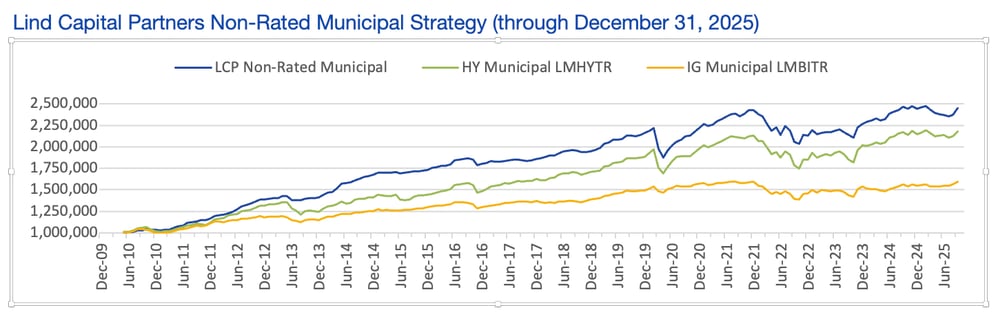
The chart above shows the increase in value of $1,000,000 invested in the LCP composite at inception (net of management fees and expenses) vs. the benchmark, the Bloomberg High Yield Muni (LMHYTR) as well as the Bloomberg Muni (LMBITR) indices (it is not possible to invest in either Bloomberg Index). Please contact us with questions regarding credit profile, returns, taxable equivalent yields or further portfolio information. Past performance is not indicative of future results.
Lind Capital Partners Municipal Market Charts