
Lind Capital Partners Municipal Market Commentary
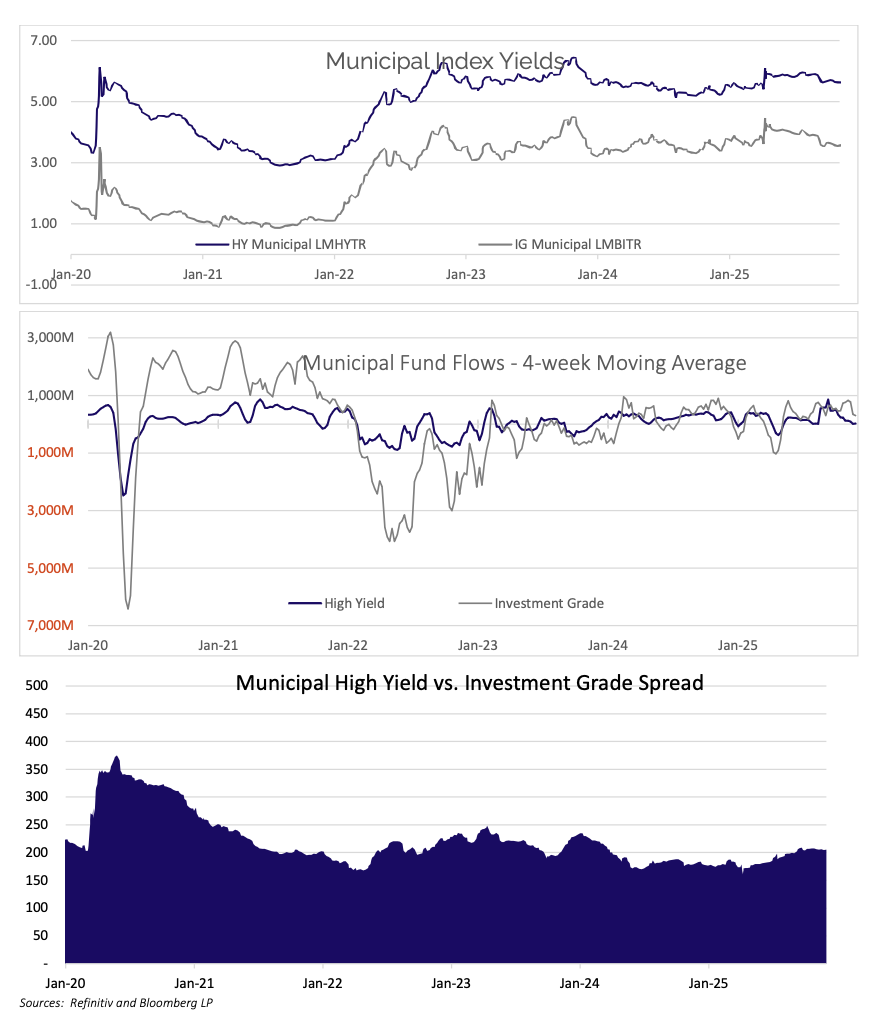
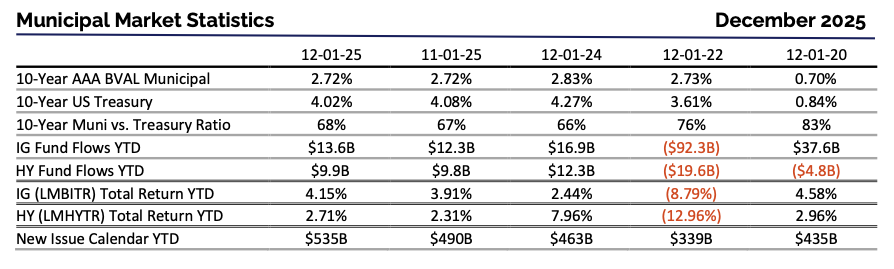 Municipal Market Performance and Benchmark Rates: Persistent demand and a generally supportive US Treasury market drove the municipal market to it’s 4th consecutive month of positive returns, despite the another month of record new issue supply. High-yield municipals outperformed the investment grade counterpart, returning +0.39% in November, versus +0.23% for IG. Despite this month’s outperformance, year-to-date returns continue to favor investment grade, the Bloomberg Barclays Muncipal Index has returned +4.15% YTD compared to the Bloomberg Barclays High Yield index returning +2.71% in 2025.
After the longest government shutdown in history, and the resultant information vacuum for policy makers and investors, US Treasury rates ultimately finished the month roughly 8 bps lower in 5 and 10 years and 1 bp higher in 30 years. Signs of a weakening labor market and declining consumer confidence ultimately renewed conviction in a December in rate cut. The AAA Municipal Benchmark was particularly rangebound this month, finishing November mostly unchanged, top to bottom. As a result, return was driven by coupon income.
Mutual Fund Flows: Despite municipal funds 7-week inflow streak coming to an end in November, flows remained firmly positive this month, totaling $1.25B for weekly reporting fund complexes. With that said, the conversion of an open-end California mutual fund to an ETF within the same fund complex, skewed fund flow data. While the distorted data is noteworthy, more notable is the conversion itself, one of several this year. Municipal Exchange Traded Fund assets continue to set annual records, as the structure remains in vogue. As we’ve highlighted previously, in our opinion, high-yield ETFs should only be used tactically (short-term) rather than strategically (long-term) given the lack of credit due diligence and surveillance on portfolio assets.
Primary Market Supply: November new issue supply stands to eclipse $50B for the 7th consecutive month – a municipal market record. The $50B figure for November is nearly 2x last year’s total, when the market was contending with the United States Presidential election. Nevertheless, this year’s November supply total was 40% higher than the trailing 5-year average (non-Presidential election years). Year-to-date supply remains approximately 17% higher year-over-year. Looking ahead to December, opportunity in the primary market should persist, as the forward-looking HY calendar already includes close to 15 new issues, a figure that only stands to grow. Combined with holiday driven investor complacency should make for a fun month.
Lind Capital Partners Municipal Non-Rated Market Commentary
We are often asked by investors concerned about duration about our preferred part of the non-rated municipal bond curve, +/- 20 years. We respond with a 3-part answer: First, as investors in a portfolio populated with unique “credits”, we feel strongly our investors should benefit from the thorough credit analysis our team provides prior to purchase and on an ongoing basis. When our credit thesis is proven, investors should continue to benefit from the attractive yields at which they purchased the bonds. Investors in short-term bonds only benefit from the attractive yield for a short period of time. In addition, as the credit thesis is proven, our portfolio holdings may benefit from spread tightening which can provide total return opportunity for our investors. Second, while duration is the measurement of a bond’s price sensitivity to interest rate changes, the correlation to other fixed rated markets is arguably more important. If the yield stays relatively constant, the duration should not matter. Our 15+ years of experience has shown that non-rated municipal bonds do not closely track yield movement in the US Treasury Market (38%) or the investment grade municipal market (82%). In fact, almost all our portfolio purchases are based on an absolute yield, not a spread to a particular index. As a result, they trade and are priced based on a yield basis and not a spread to an index. Thus, while the duration of portfolio holdings does measure price sensitivity, it is not an accurate reflection of the expected price volatility of our portfolio holdings.
Finally, as our portfolio holdings are “seasoned” over time, we anticipate credit stability or improvement and bonds moving into higher demand parts of the yield curve, 10 to 15 years. Strong demand, particularly from individual retail investors can provide additional price support as maturities shorten. Again, as the credit thesis is proven, the potential for total return trading opportunities is enhanced.
Recently, this discussion led to whether we expect to own our portfolio holdings until maturity. And generally, the answer is no. We recently received notification that one of our borrowers was redeeming our bonds at par, prior to maturity. It is representative of the life cycle of many of our portfolio holdings. In 2015, Goodwill Industries of Southern Nevada borrowed $22 million to finance the acquisition of retail or donation facilities in Las Vegas and surrounding areas. We liked the economic model of Goodwill Industries, donations provided goods to be sold, labor was inexpensive and demand was strong in the socio-economic area. Goodwill operated 21 retail stores and employed roughly 1,000 employees in the greater Las Vegas metro area.
In 2017, the Borrower filed for bankruptcy to eliminate or renegotiate some leases outside the bond issuance. Management assured bondholders that the filing was a legal maneuver to lower costs and “right size” the organization. Post bankruptcy, Goodwill operated 16 facilities, lowered employee count to approximately 600 and consolidated warehousing into a single large warehouse. Their actions were taken in coordination with and with approval from bondholders, who incurred payment interruption, but were ultimately made whole. In late November, bondholders were informed that the Borrower would be redeeming outstanding debt at par in December 2025, 10 years post the initial offering.
While a bankruptcy filing is not common among our borrowers, the ultimate outcome is, bonds being redeemed or sold prior to maturity. When the Borrower announced the bankruptcy filing, they informed bondholders of the rationale behind the filing and their intentions to not impact long-term bondholders (other than temporary payment interruption). We used the filing as an opportunity to acquire additional bonds from holders not as familiar with the underlying credit details or disturbed by the headlines. While uncommon, payment interruption does not necessarily indicate that bondholders will have to take a haircut or lose principal. Often, it provides the borrower an opportunity to reorganize their business and make changes necessary to thrive as an ongoing enterprise.
Investors in a credit portfolio should be paid for their investment and rewarded for the successful execution of a business strategy, however bumpy it might be.
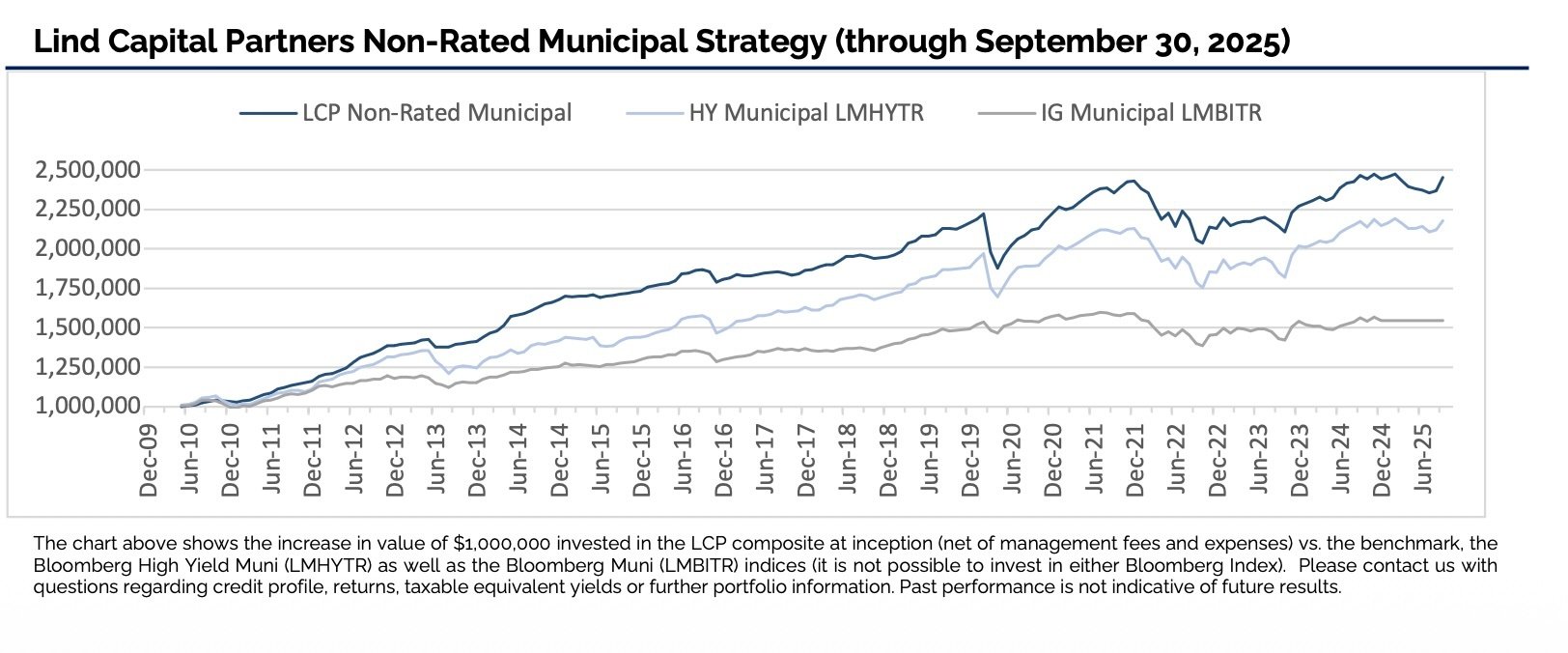
The chart above shows the increase in value of $1,000,000 invested in the LCP composite at inception (net of management fees and expenses) vs. the benchmark, the Bloomberg High Yield Muni (LMHYTR) as well as the Bloomberg Muni (LMBITR) indices (it is not possible to invest in either Bloomberg Index). Please contact us with questions regarding credit profile, returns, taxable equivalent yields or further portfolio information. Past performance is not indicative of future results.
Lind Capital Partners Municipal Market Charts